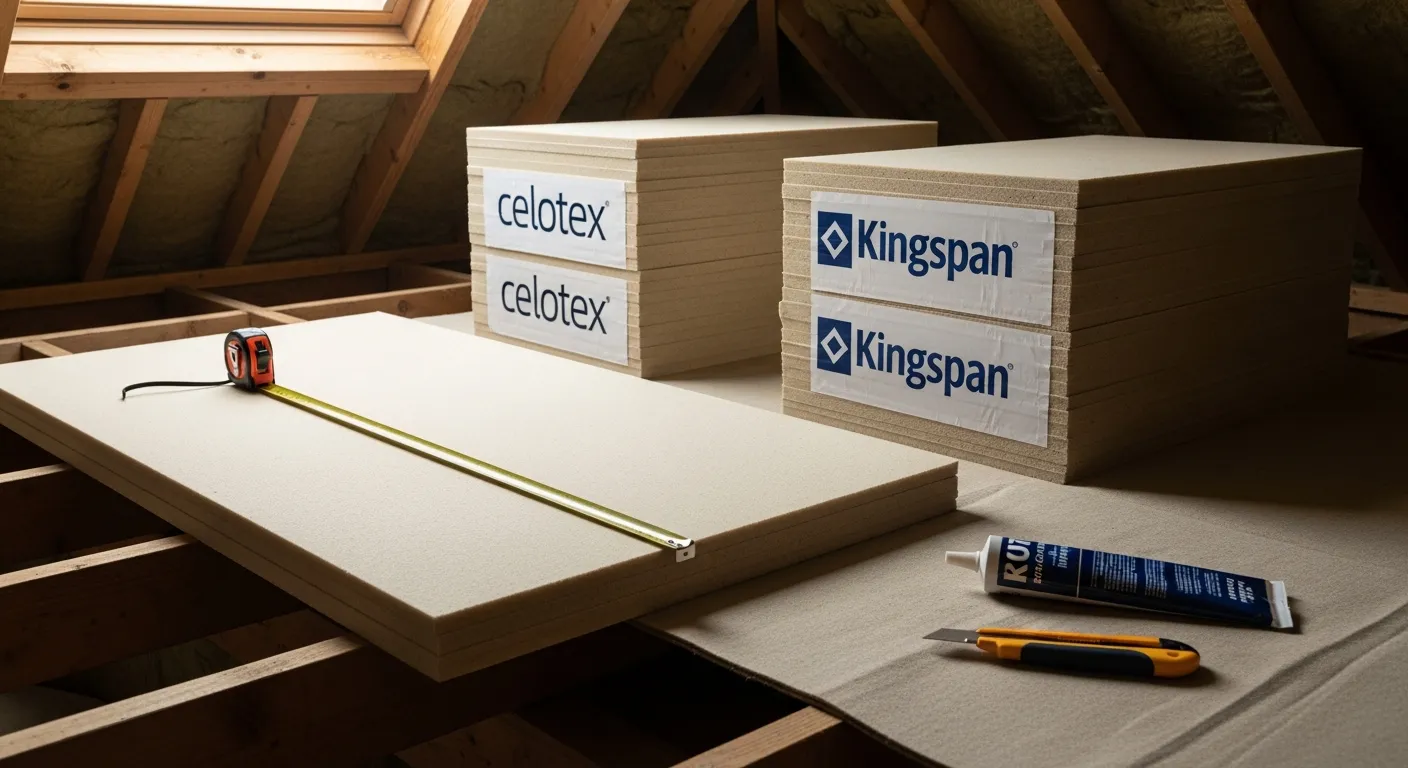
Celotex vs Kingspan: Which PIR Board Is Best?
When you're planning to upgrade your home's insulation, choosing between Celotex and Kingspan PIR boards can feel overwhelming. Both manufacturers produce...
Celotex vs Kingspan: Which PIR Board Is Best?
When you’re planning to upgrade your home’s insulation, choosing between Celotex and Kingspan PIR boards can feel overwhelming. Both manufacturers produce high-quality polyisocyanurate foam boards, but there are subtle differences that could influence your decision. We’ve installed thousands of square metres of PIR board from both brands across Coventry and Warwickshire, so we know firsthand how they perform in real-world applications. Understanding these differences will help you make the right choice for your specific project.
Performance Comparison: Thermal Efficiency and Standards
Both Celotex and Kingspan produce PIR boards that meet British Standard BS 5250 for thermal insulation, but their thermal conductivity values differ slightly. Celotex typically offers lambda values ranging from 0.021 to 0.025 W/mK, whilst Kingspan’s products generally sit between 0.020 and 0.024 W/mK. This means Kingspan boards often achieve the same U-value with marginally thinner boards.
In practice, we find this difference rarely affects material selection for most domestic projects. A 100mm Celotex board delivering a 0.022 W/mK thermal conductivity performs virtually identically to a 100mm Kingspan equivalent. The key factor is ensuring your chosen board meets the specific U-value requirements for your application, whether that’s cavity wall insulation, roof insulation, or floor applications.
Both manufacturers offer boards with various facings – from standard aluminium foil to moisture-resistant options. We typically recommend foil-faced boards for most applications as they provide an effective vapour barrier when joints are properly taped.
Availability and Product Range
Kingspan generally offers a wider product range, including specialist boards for specific applications like Kingspan Thermawall for cavity walls or Thermafloor for underfloor heating systems. Their product naming system is more comprehensive, making it easier to identify the right board for each application.
Celotex focuses on a more streamlined range but covers all the essential applications. Their GA4000, GA3000, and TB4000 series handle the majority of domestic insulation requirements. We find Celotex boards are often more readily available through local builders’ merchants, which can be helpful for project scheduling.
The thickness ranges are similar for both brands, typically from 25mm up to 200mm, though Kingspan offers some specialty thicknesses that Celotex doesn’t manufacture. For our PIR rigid insulation board fitting projects, we stock both brands to ensure we can meet specific project requirements without delays.
Installation Characteristics and Handling
From an installer’s perspective, both materials handle similarly during cutting and fitting. PIR boards from both manufacturers cut cleanly with a sharp knife and maintain their structural integrity well during installation. However, there are subtle differences we notice on-site.
Celotex boards tend to have slightly more consistent density throughout the board thickness, which we find helpful when cutting rebates for timber frame construction. Kingspan boards sometimes feel marginally firmer, which can be advantageous when installing in areas where mechanical strength matters, such as accessible loft spaces.
Both brands compress minimally once installed, maintaining their thermal performance over time. The foil facings on both products are durable, though we always recommend careful handling to avoid punctures that could compromise the vapour barrier properties.
Cost Considerations and Value
Pricing between Celotex and Kingspan varies depending on availability, bulk purchasing arrangements, and regional factors. Generally, the cost difference is minimal – usually within 10-15% for equivalent specifications. We find that local availability often influences the final project cost more than the brand premium.
Both products offer excellent longevity, with expected service lives exceeding 25 years when properly installed. The energy savings from either product will far outweigh the modest price differences over the insulation’s lifetime. We recommend focusing on getting the right thermal performance for your specific application rather than choosing purely on initial cost.
Key Takeaways
• Both Celotex and Kingspan produce high-quality PIR boards with very similar thermal performance • Kingspan offers a wider product range with more specialist applications, whilst Celotex focuses on core products • Installation characteristics are nearly identical, with both brands cutting and fitting similarly • Local availability and project scheduling often matter more than brand preference • Focus on achieving the correct U-value for your application rather than brand loyalty
What Our Customers Say
Trusted by homeowners across Coventry & Warwickshire — here's what they have to say.
"Brilliant service from start to finish. The team were professional, tidy, and explained everything clearly. Our energy bills have dropped noticeably since the new insulation went in."
"Had spray foam removed and mineral wool installed. The surveyor was thorough and honest about what needed doing. Really impressed with the quality of work."
"We had terrible condensation in our loft. They diagnosed the problem quickly, improved the ventilation, and replaced the old insulation. No more damp and the house is noticeably warmer."
Frequently Asked Questions
The thermal performance difference is minimal in practice. Both brands meet British Standards and deliver excellent insulation values. Your choice should be based on availability, specific product requirements, and what your installer recommends for your particular application.
Yes, you can combine both brands within a single installation provided they have compatible thermal values and facing materials. We sometimes use different brands for different parts of a project based on availability or specific application requirements.
Both brands offer similar value propositions. The cost difference is usually small, and both products deliver decades of reliable thermal performance. Focus on getting the right specification for your needs rather than choosing purely on price. Ready to discuss which PIR board option would work best for your home insulation project? Get in touch for a no-obligation survey and quote. We'll assess your specific requirements and recommend the most suitable materials and installation approach for your property.
Ready for a Free Survey?
No obligation. We assess your property and provide a detailed quote — usually within 48 hours.