Thin Insulation Solutions for Limited Loft Space
When your loft has minimal headroom or awkward spaces between rafters, traditional thick insulation rolls become practically impossible to install...
Thin Insulation Solutions for Limited Loft Space
When your loft has minimal headroom or awkward spaces between rafters, traditional thick insulation rolls become practically impossible to install properly. Many homes across Coventry and Warwickshire face this challenge, particularly Victorian terraces and post-war builds where roof spaces weren’t designed with modern insulation standards in mind. The good news is that effective thin insulation options exist that can dramatically improve your home’s energy efficiency without requiring major structural changes or losing precious storage space.
Understanding Space Constraints in UK Homes
Most older properties have loft spaces that seem almost designed to frustrate homeowners trying to improve insulation. Rafters typically measure just 100-150mm deep, whilst current Building Regulations recommend insulation equivalent to 270mm of mineral wool. The maths simply doesn’t work with conventional approaches.
We regularly encounter homes where the gap between ceiling joists measures barely 90mm, or where the roof pitch creates wedge-shaped spaces that taper to nothing. In converted lofts, the situation becomes even more complex, with dormer windows, party walls, and access hatches creating irregular spaces that thick batts can’t navigate effectively.
The key insight is that thickness isn’t the only route to effective thermal performance. Modern thin insulation materials achieve impressive R-values through advanced material science rather than sheer bulk. Multi-layer reflective systems, vacuum insulation panels, and high-performance rigid boards can deliver excellent results in spaces where traditional materials fail completely.
Multi-Foil Systems: Maximum Performance in Minimal Space
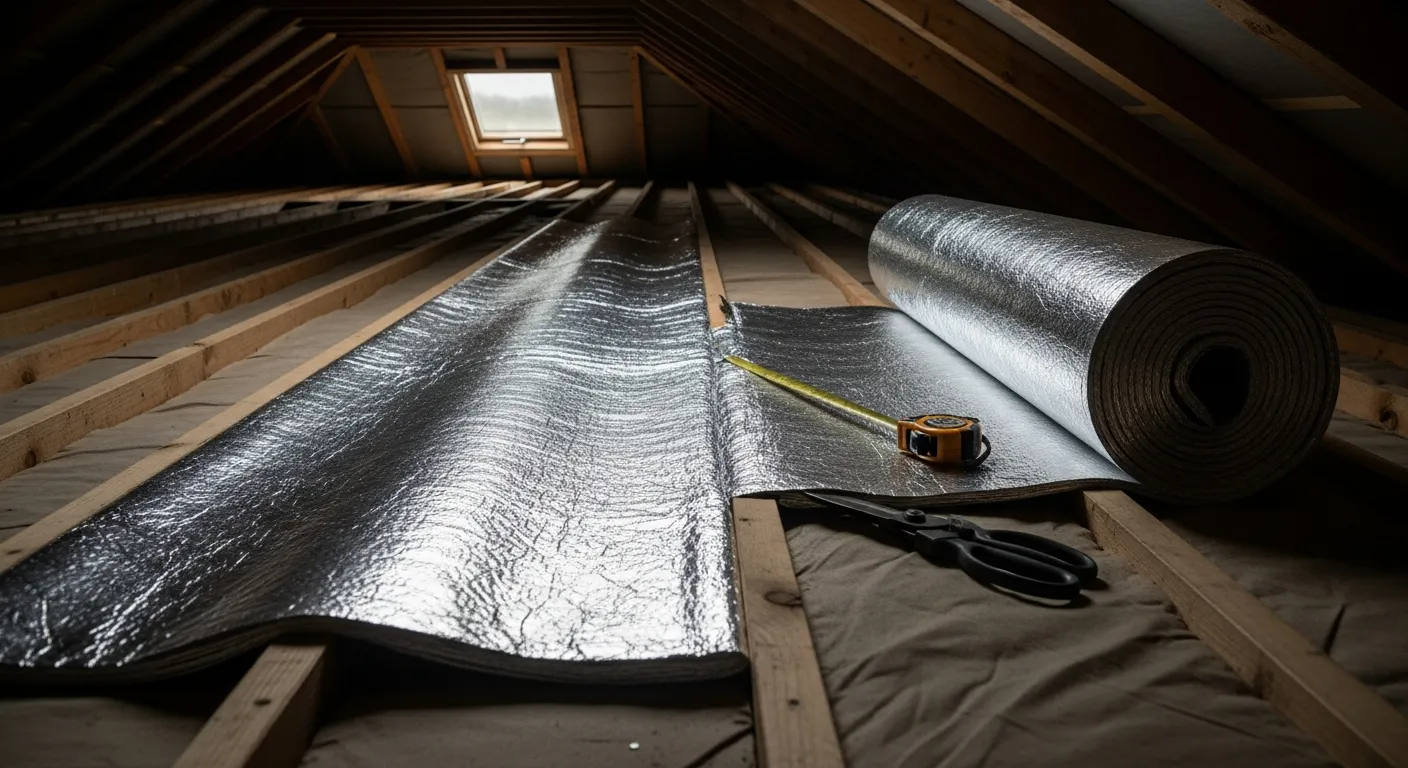
Multi-foil insulation represents one of the most effective approaches for space-constrained lofts. These systems typically measure just 20-50mm thick yet provide thermal performance equivalent to much thicker conventional materials when installed correctly.
The technology works through multiple reflective layers separated by insulating cores, creating thermal breaks that dramatically reduce heat transfer. Unlike mineral wool, which relies purely on trapped air, multi-foil systems actively reflect radiant heat whilst providing excellent resistance to conductive and convective losses.
Installation requires careful attention to air gaps and continuous coverage. We’ve found that maintaining the specified air gaps on both sides of the foil is crucial—without proper spacing, thermal performance drops significantly. The material needs breathing space to function effectively, which actually works in your favour in tight loft spaces where maintaining small air gaps is easier than accommodating thick batts.
Our multi-foil insulation installation service focuses heavily on these space-restricted applications. We’ve developed techniques for working in challenging roof spaces, ensuring proper installation even where headroom barely allows us to move around.
High-Performance Rigid Boards for Specific Applications
Polyurethane and phenolic foam boards offer another excellent option for limited spaces. These rigid materials deliver outstanding thermal performance—typically achieving R-values of 0.20-0.25 m²K/W per centimetre of thickness. This means a 50mm board can outperform 100mm of conventional mineral wool.
The boards cut cleanly and fit precisely between rafters or over ceiling joists. For irregular spaces, we often use a combination approach: rigid boards for the main areas, with flexible multi-foil material handling the awkward corners and junctions that boards can’t accommodate.
Fire performance requires consideration with rigid boards. Most modern types achieve Class E fire ratings, which meets Building Regulations for domestic loft spaces, but this needs checking during the specification process. We always verify fire ratings and provide certificates showing compliance with current standards.
One significant advantage of rigid boards is their moisture resistance. Unlike mineral wool, which can lose effectiveness if it becomes damp, closed-cell foam boards maintain their thermal properties even in slightly humid conditions—useful in older properties where minor leaks occasionally occur.
Vacuum Insulation Panels: Space-Age Performance
For extreme space constraints, vacuum insulation panels (VIPs) deliver thermal performance that seems almost impossible. At just 20mm thick, a quality VIP can match the performance of 200mm of conventional insulation—a ten-fold improvement in space efficiency.
VIPs work by removing air from between reflective barrier layers, creating a near-perfect vacuum that eliminates convective and conductive heat transfer. The technology originally developed for aerospace applications but has become increasingly viable for domestic use, particularly in renovation projects where space is at a premium.
The main consideration with VIPs is cost—they represent a significant investment compared to conventional materials. However, for specific applications where space constraints would otherwise make effective insulation impossible, they can prove surprisingly cost-effective when you consider the alternative of major structural modifications.
Handling requires care during installation, as puncturing the vacuum barrier destroys the panel’s effectiveness. We typically recommend VIPs for accessible areas where future maintenance won’t risk damage, whilst using more robust materials in spaces where building services or storage might create puncture risks.
Key Takeaways
• Multi-foil systems deliver excellent thermal performance in spaces as thin as 20-50mm when installed with proper air gaps • High-performance rigid boards can achieve better R-values than thick conventional materials whilst fitting between standard rafter depths • Vacuum insulation panels offer space-age performance for extreme space constraints, though at premium cost • Professional installation becomes even more critical with thin insulation systems—air gaps, thermal bridging, and continuous coverage affect performance significantly • Building Regulations compliance remains achievable even with space constraints through careful material selection and installation techniques
What Our Customers Say
Trusted by homeowners across Coventry & Warwickshire — here's what they have to say.
"Brilliant service from start to finish. The team were professional, tidy, and explained everything clearly. Our energy bills have dropped noticeably since the new insulation went in."
"Had spray foam removed and mineral wool installed. The surveyor was thorough and honest about what needed doing. Really impressed with the quality of work."
"We had terrible condensation in our loft. They diagnosed the problem quickly, improved the ventilation, and replaced the old insulation. No more damp and the house is noticeably warmer."
Frequently Asked Questions
Yes, modern thin insulation materials can equal or exceed the performance of thick mineral wool through advanced material technology. Multi-foil systems and high-performance boards achieve this through reflective barriers, superior material properties, and reduced thermal bridging rather than relying purely on thickness.
Multi-foil systems can work effectively in spaces as shallow as 40-50mm total depth, including necessary air gaps. Even spaces between 75-100mm rafters can accommodate high-performance solutions that meet current Building Regulations when properly specified and installed.
Absolutely. Thin systems are often more sensitive to installation quality than thick materials. Air gaps, thermal bridging, and continuous coverage become critical factors. Professional installation ensures these systems achieve their designed thermal performance rather than underperforming due to technique issues. --- **Ready to solve your limited loft space challenge?** Contact us for a free survey where we'll assess your specific space constraints and recommend the most effective thin insulation approach for your home.
Ready for a Free Survey?
No obligation. We assess your property and provide a detailed quote — usually within 48 hours.